
 Phone. +45 76 24 50 20
  info@ivf-syd.dk


Your first step is to choose a sperm bank. On the sperm bank’s website, you can browse donor profiles and find the specific profile you wish to use.
Please make sure to select the donor type you prefer (Anonymous, ID‑Release, or Non‑ID Release).

Donor sperm is used in fertility treatment when pregnancy cannot be achieved with a partner’s own sperm – or when there is no male partner.



At IVF‑SYD, we guide you safely through the entire process – from the first considerations and choosing a donor to the treatment itself.
On this page, you can read about:
When you choose treatment with donor sperm, you will need to decide which type of donor you prefer.
In general, there are two categories:
• Anonymous donation
• Non-anonymous donattion
The difference mainly lies in how much information is available about the donor – both to you and to any future child – and whether the child will have the option to learn the donor’s identity when they turn 18.
With anonymous sperm donation, you have access to what is known as a basic donor profile. The basic profile includes the following information:
Neither you nor any future child will be able to obtain additional information about the donor – now or in the future.
The anonymity also applies to the donor, who likewise will not be able to receive any information about any children conceived with his sperm.
With Non‑ID Release sperm donation, you can access an extended donor profile in addition to the basic profile (height, weight, hair colour, eye colour and skin tone).
The extended profile may include:
The donor’s identity can never be disclosed – neither to you nor to any future child. The donor will likewise not be able to receive any information about any children conceived with his sperm.
With ID‑release (open) sperm donation, the donor’s identity is not known to you at the time of donation.
However, the donor has agreed with the sperm bank that any future child may obtain the donor’s identity – typically when the child turns 18.
As part of the treatment, you have access to an extended donor profile in the same way as with Non‑ID Release donation.
The donor cannot be regarded as the legal father of the child and will not receive any information about any children conceived from his donation.


The choice between Anonymous, Non‑ID Release and ID‑Release donation is personal and depends on your wishes and considerations for the future. We always review the options thoroughly together with you, so you can make an informed decision.


| Donor sperm type | IUI (Insemination treatment) | IVF (Egg retrieval) |
|---|---|---|
| MOT 2 | % | √ (ICSI if applicable) |
| MOT 5 IUI | % | √ |
| MOT 5 ICI | % | (√) 2 straws recommended |
| MOT 10 IUI | √ | √ |
| MOT 10 ICI | (√) 2 straws recommended | √ |
| MOT 20 IUI | √ | √ |
| MOT 20 ICI | √ | √ |
Here you’ll find answers to some of the questions we are most often asked about treatment with donor sperm.
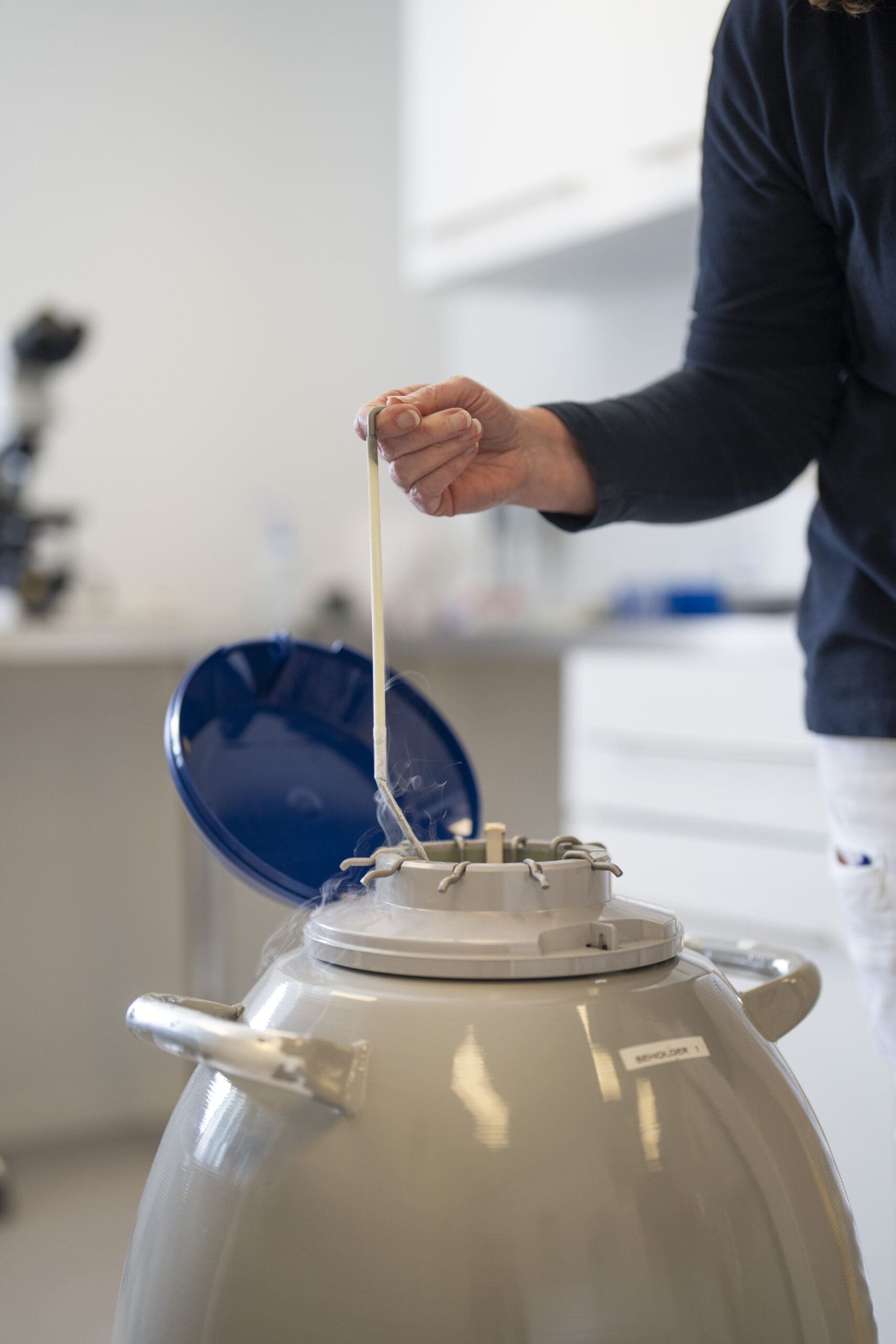
There are 2 different types of straws, called IUI and ICI (most straws are IUI, which we recommend, but we can also use ICI)
The difference between IUI and ICI is:
See the table below.
In most cases, ordering 1 or 2 straws will be sufficient, but you can easily order more straws to save transport costs. However, you cannot return excess straws to the sperm banks, so you should of course take this into consideration.
At IVF-SYD, straws are stored free of charge for the first year, after which storage is charged annually, according to our price list.
The straws should ideally arrive at the clinic at least one week before the planned treatment – so please make sure to order in good time.
Shipping: Whether the straws are shipped on dry ice or in liquid nitrogen (N₂) makes no difference to us.
However, please note that if the straws are shipped on dry ice, we can only receive them on the following days: Monday, Tuesday, Wednesday and Thursday.
Once pregnancy has been achieved, you may consider reserving additional straws from the same donor if you wish to have genetically related siblings.
Please note: the straws must be ordered in the name of the woman who will be undergoing treatment.
All sperm donors are thoroughly tested and screened in accordance with current guidelines
Donors are screened for hereditary conditions and tested for infectious diseases.
Even though the screening process is extensive, genetic or infectious risks can never be completely ruled out.
A great deal of effort is made to minimise the risks associated with treatment using donor sperm.
Donors are tested to ensure they are free from serious infectious diseases such as HIV and hepatitis.
As with all fertility treatments, the risk can never be reduced to zero. If, contrary to expectations, any circumstances arise that may be relevant to the donor or to children conceived through donation, it is important to contact the clinic.
When undergoing treatment with donor sperm, legal documents regarding paternity or co‑maternity must be completed before treatment can begin, in accordance with current danish legislation.
We will inform you about which documents are relevant in your situation and guide you through the process.
We can only provide guidance based on Danish legislation.